
A Complicated Past
Season 2 Episode 9 | 24m 3sVideo has Closed Captions
The descendants of Quanah Parker come together. A writer explores ruins of Texas missions.
The descendants of Quanah Parker gather with relatives over a shared heritage and tragedy. A writer explores the ruins of Texas missions to learn about who we are.
Problems playing video? | Closed Captioning Feedback
Problems playing video? | Closed Captioning Feedback
Production Support Provided By: Riptide Waters LLC; Texas Parks & Wildlife Foundation; Texas Rural Funders, H-E-B”
Support provided by:


A Complicated Past
Season 2 Episode 9 | 24m 3sVideo has Closed Captions
The descendants of Quanah Parker gather with relatives over a shared heritage and tragedy. A writer explores the ruins of Texas missions to learn about who we are.
Problems playing video? | Closed Captioning Feedback
Where to Watch Texas Monthly Presents: The Story
Texas Monthly Presents: The Story is available to stream on pbs.org and the PBS app.
Providing Support for PBS.org
Learn Moreabout PBS online sponsorship- [Katie] The history in Texas is enormously complicated.
- There's so much more to this story.
- And somewhere in between is what people talk about.
- So if you're going to understand the foundations of Texas, you've got to look at these missions.
- Even the shards tell a story.
- And to accept that we all share the same blood.
- It's all in here.
- We all call this home, and this has been our home for a long, long time.
(dramatic music) (gentle music) (dramatic music) (dramatic music) - [Katie] The history in Texas is enormously complicated, but it's usually not at the forefront because the story isn't well known.
The Parker story is very well known.
The conflict is right out in the open.
When I heard that round a hundred Parker relatives come together every year at the fort, that was something I needed to see.
- [Navigation Audio] Turn left, then arrive at your destination.
- Oh, that's it.
It's tiny.
I'm Katie Vine.
I wrote "The Reunion" for "Texas Monthly".
The morning of May 19th, 1836, 40 miles east of modern day Waco, the Parkers were attacked by a group made mostly of Comanches.
Many of the residents were killed and several were kidnapped.
- So the fort itself, so this is the approximate location.
We don't know if this was the exact location, but the approximate location.
The mistake they made was building it too close here to Comancheria.
And in 1836, they found out why they made that big mistake.
- [Katie] One of the most noteworthy captives was Cynthia Ann Parker, who was then a pre-teen.
She became the wife to then Comanche Chief Peta Nocona and a proud mother to the last Comanche chief, Quanah Parker.
The raid of 1836 led to the blending of Comanche and Anglo bloodlines, a complicated identity that the Parkers carry today.
- Cynthia Ann Parker goes from the comfort, if you will, of being with her Baptist family in like one acre, taken, and suddenly her world becomes 250,000 square miles of Comancheria.
- Right.
- And here's Comancheria and Grosebeck is right there.
I mean, it's like right on the line.
So look at the guy, this is Corey on this horse.
I don't know why he's riding this horse in here.
Whose horse is that?
- I don't know.
- You don't know whose horse?
- I'm Comanche so I just snagged it.
- The problem with the Parker family, there's a lot of folklore and realism and somewhere in between is what people talk about.
- Some time has passed, let's say.
I'd always been interested in the story, but I did not realize that the story was still unfolding for her relatives.
What was it about being a Parker that was still very important to these folks after all this time?
- As a little girl I came here with my family.
- Really?
Wow.
- So through the years, it was my grandfather, then my father.
Now here I am trying to represent our part.
We have people from all different branches, so we're the Cynthia Ann part and then we've got the Quanah Parker, which is coming.
So we're all coming together.
I think that's really cool.
- Yeah.
- I like that.
I think that's a symbol of just forgiveness and coming together, so.
- Cynthia Ann Parker was recaptured by the Anglos and by some accounts protested her recapture by starving herself to death.
In Oklahoma, they primarily celebrate Quanah.
And so coming to Texas and exploring Quanah Parker's roots and his mother's experience complicates some of that picture.
- You come here and you can feel the belonging.
And for me, I get a calm feeling.
I feel like I've come home.
I was adopted and raised in Tennessee, and then after the adopted mother passed, I located my birth family in Oklahoma and was welcomed back by my grandmother.
And the rest is history.
- Powerful story to find out is part of your past.
- And you've got our white family and you've got our red family.
There are still a few on each side that when they look at each other, it's like, "Okay, we're in the same room.
I know you're here, but I'm not going to acknowledge you."
There's that little thing that keeps them separated.
And so my goal is to bring people together from both sides and unify the family.
I want everybody to be at peace with one and to accept that we all share the same blood.
- There's definitely a difference from the Parker side and Cynthia Ann's side- - But you inhabit all of it.
- Yeah.
And so.
- She ended up living with the Comanches and when they recaptured her, she wanted to go back because they were then her people.
So it must say something that they must have treated her very well for her to want to go back because she didn't want to stay with her family here.
For her to be the mother of the chief, a leader, a war chief of the Comanche people, that says a lot about her too.
- You got it?
- You get it.
- All right.
Three, two, one.
- Whoa.
- Whoa, that's a good one.
- I packed it.
- Whoa.
Whoa.
- First time.
- He goes, you're right.
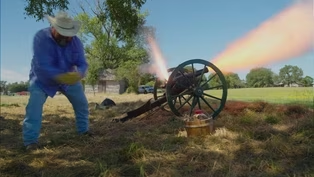
- I was artillery.
I was artillery in the army.
- That look great.
- The legacy of Quanah Parker marries these two forces that were in conflict.
They were sort of the origin of this place.
- The first people of this country, we're always of this country.
We're the blood of this country, of this land.
And the combination of what happens between the two, we're everything American.
We are the blood that has always been here and the blood of those that braved a new land to make a new country.
We are everything that is American.
That's who we are as Parkers, both white and Comanche.
- [Katie] That's great.
Thank you.
- [Tina] You see her beret is the American flag and her little shoes are beaded with the American flags, so they tell her story.
- [Katie] As everything was wrapping up, a few of us drove down to the cemetery where the remains of five of those killed in the raid are said to be buried.
- When there's something that we're going to put down, like pain and anger, we take a stick and we break it.
And once we break it, we let it go.
We don't come back to that.
So with what happened here for us and our little family is to make this offer of the past.
We're going to make tobacco and water and then we're going to break this stick.
And when we're done with that, we're finished with our pain for what happened here that day.
So Ollie put the tobacco down.
Big Ollie, you offer water.
Where's Cynthia Ann's children?
- No more.
(Tina sniffling) Okay.
Now we can go look around.
(participant chanting) (participant's chanting continues) - [Katie] Some of the relatives who'd never gone to the cemetery, they didn't know where to place this story and they felt the need to acknowledge it and release it.
I assumed that there would be a lot of history that they'd already sort of worked through, and to my surprise, that really wasn't the case.
There were some people who were still struggling with that history.
To watch the Parker family wrestle almost 200 years after the raid with their family legacy was an incredible privilege.
(wind whooshing) (thoughtful music) - It's easy and convenient to think of Texas as one thing.
The truth is it's not.
It's history is complicated, diverse in its characters.
And with the current demographics, the current political system and the current issues on the border, it's more important than ever to tell stories like those about the lost missions.
I'm Jose Ralat and I wrote "Nearly Forgotten" for "Texas Monthly".
I travel about two to three weeks per month for "Texas Monthly" in the capacity as taco editor.
When you're on the road for a thousand miles in one day, you need a break?
I come across a lot of historical markers, which is what led me to the Lost Missions.
This is New Braunfels.
It's a city park where Native Americans would come to the local springs.
And because of that, the Spanish decided it was a good place to build a mission, and that's why we're here.
We're trying to find the mission.
Man on a mission.
That's me.
I'm a man on a mission.
The missions were fortified settlements built around a church where Franciscan friars worked to convert local indigenous populations.
There were many missions spread across Texas from east to west.
When people think about missions in Texas, they're thinking about the Alamo, they're thinking about all the wonderful, well-preserved missions in San Antonio.
But the types of missions I was seeing were sites that were just rocks.
Some were just fields.
Some would say this is the approximate site.
Here it says earlier located 100 miles northeast.
So this isn't the first site, which makes it even older than 1756.
There was once a mission here, but no brick or rubble remains.
Without this plaque, we wouldn't know that the mission was here.
It was one of the places where Texas got its foundations.
I got hooked real fast and I realized I needed to visit as many as I could and write about them.
The main mission that I went to is Socorro Mission in Socorro, Texas, just outside of El Paso.
It is gleaming white, gorgeous, and Tonya Magda is the caretaker of the church.
- My name is Magda Maureira and I am a docent, a volunteer at the Socorro Mission, basically keeping everything afloat.
I am one of 10, 11 volunteers that keeps the mission open seven days a week.
Welcome to the Socorro Mission.
For how many of you is it a first visit?
We meet people from all over the world.
Buenos dias.
- Buenos dias.
- De donde nos visitan?
I've had visitors walk in and openly weep.
It's just sacred space and we go back so far.
- She's also the keeper of that mission's history and the stories of the people who make up that history.
- [Magda] The Piro people came from New Mexico after the great Pueblo revolt in 1680, and the people that settled here in Socorro have just a continuous line to the present day.
- Magda's roots are in Socorro mission.
- I'm from the Trujillo family and they were in that first bunch that arrived here.
I was born and raised here.
- She is Piro.
- We are from here and have not left.
- When I spoke with Magda at the church, it was obvious that this was her and it was her honor to lead the tours, to run the gift shop, and to share stories.
- You've been coming here a long time.
- A long time.
Yeah, a long back.
Most of my relatives are buried out there.
- Oh okay.
- We've been here for many generations.
- I'll go say hi to them.
- Yeah.
Okay.
We're an untold story basically, and so we thrive and we live to tell our story.
And through the mission, which is really the epicenter for us, we are able to share that story in a very concrete way.
The Piro left amazing designs on the beams in the ceiling of the mission.
So really above us, at any given moment, we have our people still very much here.
(group singing together) It's a living historical site.
It's not a museum.
You know, adobe is earth.
Adobe has to breathe.
So I feel like the walls breathe just like we breathe.
We're all together in communal breath.
- The beauty of the missions is in contrast to the complicated history, sometimes the violent history.
Many indigenous populations were forcibly relocated and they were the ones who did the labor.
The people now embrace it as a sign of what they've overcome and they maintain their faith.
- We carry all of that.
You know, the good and the bad and the ugly and the sacred and the profane, it's all in here.
- If we don't make sure to point out the complexities, then we will whitewash the story and it's not a simple story.
To get a better sense of what life was like while those missions were active, it was important to me to speak with archeologists.
Hi.
- Hey, good to meet you.
- [Jose] So I went straight to the top.
I met with Bradford Jones, Fifth State archeologist.
- The center of a lot of early Texas, you know, it is the mission.
So if you're going to understand the foundations of Texas identity, you've got to look at these missions.
Socorro is, you know, our oldest Texas mission.
- [Jose] The Texas Historical Commission Library is in a former church, which makes researching Texas missions extraordinarily rich.
- History, if you don't dig into it, it becomes a very simple narrative.
And when you start telling all these other untold stories, the aspects that aren't part of the kind of mainstream history, I mean, I think it's what draws people in.
- [Magda] We're at the site of the old Socorro mission.
We're stepping on sacred ground, very, very sacred ground.
And as you get further in, that's where the walls of the mission were.
- The mission was abandoned in 1829 after a flood.
- So it's in 1829 that they move half a mile and build here, and this is it.
This is the origin.
The current mission is a replica of this mission.
They carried over there what started here.
- Every piece under that sediment is a piece of Texas history.
- I brought a few things here from the collections from the Old Socorro mission site.
I find these two pieces, they're my favorites and I'm sure you're going to appreciate this as a food writer.
- Yeah.
- These are molcajetes.
- Wow.
- And you can see, pick it up.
They've got these rough areas.
- Oh, I can touch it?
- Yeah.
- Oh.
- Just don't drop it and break it.
- I won't.
- We'll both get in trouble.
- It's a lot of fun to be able to put the history into your own hands.
- [Bradford] And so you would take chilies and you would run them on there and other to make a salsa.
- Oh, wow.
- I like these because they show this continuity of food traditions that are coming into these missions and being adopted.
You know, we all love to bring the foods we eat, and then we learn how to adapt them to where we're at.
- Right.
- Even the shards tell a story and are able to tell us just what wonderful potters the Piro were.
And of course, all kinds of good food were provided here, and they were known, that was their banner description.
They were excellent farmers and sharing with others.
- Preserving Texas archeology isn't easy.
95% of Texas is private land, so it's up to the stewardship of the landowners to be responsible and take an interest in preserving and protecting it.
- 12 acres have been bought by the Texas Historical Commission, so that is secure for future work.
Much remains to be done to uncover it.
- Preserving missions is a constant effort.
- We take pride in our mission that we want to preserve it, and one way of preserving our mission is by not letting it fade away and keeping up with it, cleaning it.
And it's like cleaning our souls.
- It's because of families like Magda's that Socorro Mission is in pristine condition, that it's preserved.
- When I die, this is where I'm going to be.
I'm going to be here at home, and this mission is my home.
- Since I started my work visiting missions, I like to think the presence of the people who once called this area home remain.
None of this to me is in the past.
It is very much something that continues to make us Texan.
It's beautiful.
Honoring these sites is especially important right now.
This period of time in 2026 is one of political partisanship and a raging debate of who is an American, who is not an American.
And I saw it firsthand when I got pulled over by ICE on the way to look at missions.
These missions remind us that Texas has always been made up of all kinds of different people and its borders have changed, not just because of a wild river, but because of who was in charge and why.
- I think I want people to have a sense of perspective.
We do tout the origins of the Pueblo 345 years ago, but it has been enriched by the newer immigrants, the different waves of migration that have come to this valley.
That cannot be overlooked.
(thoughtful music) - There are about 25 to 30 missions that archeologists know about, and I've been to 18.
There is likely more, and that makes for a lot of untold history.
It's supposed to be on the road side of the Chick-fil-A, which is to say the front.
The original mission was right here, where now we have a Chick-fil-A.
I'm going to continue visiting missions.
I'm going to continue stopping at every Texas historical commission plaque and hopefully tell more stories.
(thoughtful music) The stories of early Texas aren't fully told.
- I love any story where you can dig through the layers and realize why some history, some rich history that maybe has been swept under the rug is playing out in real time now.
- I think it's important that we study it a little closer.
It gives us a better understanding of what Texas was, what Texas is, and what Texas will be.
Video has Closed Captions
Preview: S2 Ep9 | 30s | The descendants of Quanah Parker come together. A writer explores ruins of Texas missions. (30s)
Providing Support for PBS.org
Learn Moreabout PBS online sponsorship










Support for PBS provided by:
Production Support Provided By: Riptide Waters LLC; Texas Parks & Wildlife Foundation; Texas Rural Funders, H-E-B”