Made Here
The Celebration: Exploring Vermont's Wild & Scenic Rivers
Season 23 Episode 3 | 29m 24sVideo has Closed Captions
A seven-day journey along Vermont’s Upper Missisquoi and Trout Rivers
A dedicated group of paddlers embarks on a seven-day journey along Vermont’s Upper Missisquoi and Trout Rivers, celebrating the 10th anniversary of their Wild & Scenic designation.
Problems playing video? | Closed Captioning Feedback
Problems playing video? | Closed Captioning Feedback
Made Here is a local public television program presented by Vermont Public
Sponsored in part by the John M. Bissell Foundation, Inc. and the Vermont Arts Council| Learn about the Made Here Fund
Made Here
The Celebration: Exploring Vermont's Wild & Scenic Rivers
Season 23 Episode 3 | 29m 24sVideo has Closed Captions
A dedicated group of paddlers embarks on a seven-day journey along Vermont’s Upper Missisquoi and Trout Rivers, celebrating the 10th anniversary of their Wild & Scenic designation.
Problems playing video? | Closed Captioning Feedback
Where to Watch Made Here
Made Here is available to stream on pbs.org and the PBS app.
Providing Support for PBS.org
Learn Moreabout PBS online sponsorshipMore from This Collection
Explore the natural word and environment of our region.
 New
NewBeneath The Surface: Journeys of Scientists and Discovery in Lake Champlain
Video has Closed Captions
Follow the personal and professional journeys of scientists working to protect Lake Champlain. (24m 50s)
Wind Power: Vermont Leads the Way
Video has Closed Captions
1941 in Vermont, the 1MW Smith-Putnam wind turbine connected to the grid. By Ian Sweet of Waterbury. (56m 21s)
Why Did This Farm Survive VT's Extreme Floods?
Video has Closed Captions
How regenerative farming helped one Vermont farm survive historic 2023 flooding. (17m 8s)
Video has Closed Captions
Vermont 4th graders raise baby trout, discovering ecosystems and connecting with nature firsthand. (15m 29s)
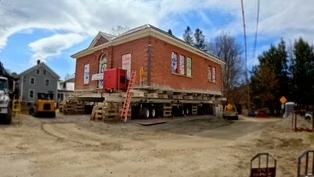
Making History: Moving the Johnson Library
Video has Closed Captions
How the Town of Johnson, Vermont got creative to save their 100 year old library from flooding. (7m 29s)
Video has Closed Captions
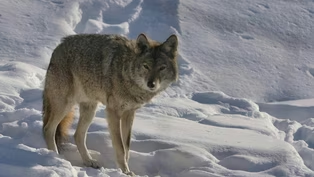
Investigating the eastern coyote hunting controversy in Vermont. (38m 6s)
Video has Closed Captions
In New Hampshire’s small fishing and aquaculture industries, women have broken down barriers. (45m 31s)
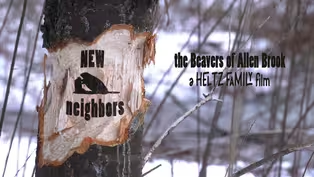
New Neighbors: The Beavers of Allen Brook
Video has Closed Captions
A Vermont homeowner sets out to learn about his new neighbors, the beavers. (29m 37s)
Video has Closed Captions
The story of a New England entrepreneur rehabilitating old dams to produce clean energy. (27m 42s)
Harry's - One Vermont Community and the Flood of 2023
Video has Closed Captions
Harry's Hardware in Cabot, Vermont and the flood of July 2023. (19m 45s)
Video has Closed Captions
A story of the July 2023 Vermont floods that devastated a street but not the community spirit. (37m 21s)
Defending The Dark - Preserving the night sky in Maine
Video has Closed Captions
How saving the dark sky can reduce the harmful effects of light pollution. (28m 53s)
Providing Support for PBS.org
Learn Moreabout PBS online sponsorshipIt begins as a whisper in a lonely place high up among the bracken and the sedges, unnoticed, trivial.
A river swells with rainfall, shrinks with drought, may slacken to a stingy trickle or strengthen to a torrent.
Its voice is never Jabber, only song.
A river may appear impressionable, foolish, easily led, and yet, if turned aside, will, in the end, come round to its intended course.
It cannot be contained by fences, ditches, levees, dams, leaves, everything it has ever owned behind it In the past, it runs its own way home.
Everyone's got a life jacket, everyone's got a paddle, Everyone's got their car keys.
We're getting rain tonight, but unfortunately, right now, the water level is quite low, so there will be exposed rocks.
There will probably be a few hidden rocks, and there will be some gravel bars.
There will be spots where we all just get stuck, sorry.
Intro to the upper Missisquoi.
You in the 1960s people started recognizing that dams have a big impact on our rivers and the way that they flow, and so there was a big push to protect a lot of our rivers, especially out west.
The Wild and Scenic Rivers Act was started by the feds.
If a river is recognized as wild and scenic, it receives funds from the federal government to help in protecting and preserving so a wild and scenic river means you can't build within the river.
There can't be a dam in the river, and generally it's a protected area.
Rivers are meant to be wild, and the protection for the Wild and Scenic Rivers act really makes sure that we can protect our rivers the way that they're meant to be and help mitigate some of the negative impacts that we have generally environmentally.
It provides a level of protection that encourages people to utilize the river in responsible ways.
A lot of that is to do with connecting people with the river.
We came up with the idea of providing day paddles to do that.
We're celebrating 10 years of designation by paddling all 46.1 miles.
We're splitting it up into seven days, achievable river miles.
We're gonna fully support it.
We can provide the boats for people and knowledgeable guides so everyone feels safe, and we'll get people out on the river, and hopefully that will help amplify the awesomeness that our rivers.
At five years we did a sojourn paddled sections of our designated River, just basically have fun on the river, and this year makes 10 10 years, so we're ready for another.
We are celebrating all the work that led to getting a chunk of our river designated Wild and Scenic, getting recognition on a national scale, and it serves as an opportunity to make sure that people know that we have this awesome feature.
Getting out and moving at the speed of the river is a different kind of connection.
And it really worked for me, and I think it can work for other people to go.
This is important.
This is something I want to experience.
This is something that I want to preserve.
The upper Mississquoi starts in a pretty rural area of Vermont known for being farmland.
But down here, this stretch of the river is about as natural as it can get.
It's just a great place to paddle if it's been dry for a long time, it's oh well, do a little more gravel bar hopping upper Mississquoi, really nice to be on the one.
Water with people that are enjoying themselves.
I always am a little nervous, especially when the water is low.
It's like, you know, you're kind of walking your boats, but everybody's super happy and got a great attitude, and that makes me feel like, these are my people.
We're gonna have a great time.
This is definitely the lowest water levels we'll have, hopefully for the whole trip.
The Upper missiscoy is pretty notorious for having low levels.
It's a Vermont river.
You know, you're here to experience Vermont.
We got a gem.
We got a great little spot.
Even after 10 years, some people don't know it exists.
So I think it's great to get the word out and let people know what's available to them because of this designation and because of the National Park Service, as the designation of wild and scenic indicates it is a stretch of running river that is unspoiled.
Day two, we will get to explore what's probably the most wild section of our river, the more extreme paddling that we have you.
It's only about a four mile section, but some of the most remote chunk of the Missisquoi, we do have high water.
Thankfully, it was at 88 CFS, where I looked last night, and now it's somewhere around 500 probably.
So that's great.
With this high water, we're gonna be scouting everything.
Such a stunning gorge.
Water is pretty high.
You're doing great!
Amazing water in Vermont in the summer, I paddle an open canoe, so it means that I'm ending up Portage and drag.
There's no trails or anything.
So it was pure bushwhacking.
It's like being in wildest Canada.
It has an untouched feel when you're going through it.
That's exactly why we're here.
Every drop of water connects us to a river, connects us to a lake.
Anything I can do to get people to realize that this river is ours, whether or not we own the land on either side of it, we are participating in keeping it clean, keeping it healthy.
The more I can get people to care about it, the more I can encourage them to think about it as a very public resource, the better we're going to be.
My husband and I used to go on long canoe trips every summer in northern Quebec and Labrador and every time I came back in the local newspaper, I saw an ad for meetings to help clean up the river, and it was a group called Missisquoi River Basin Association.
Then I started going to meetings, and that was probably about 25 years ago, probably about five years after that, I went to a river rally, which is a conference, a national conference about rivers.
And one workshop I was in, I met people who worked for the National Park Service, and they were telling me about this amazing program and that we could get federal dollars to help clean up the river.
It just all seemed too good to be true.
Oh, the thing that got me to they said, New Jersey has three Wild and Scenic Rivers, and Vermont doesn't have any.
And I said, that is not right.
My name is Lindsey.
I'm the director of the upper Missisquoi and trout rivers Wild and Scenic committee.
Super excited to have you guys join us.
This is day three of seven days where we're exploring all 46 miles of our wild and scenic river from the gorges.
We'll do a stretch from big falls, which is the tallest natural falls in Vermont.
We'll paddle from below big falls to the Canadian border.
I'll be honest, I've never been on this stretch of the river.
This is my first time going out for a paddle with these guys.
I'm looking forward to it.
Water is nice and high.
Think it'll Good day.
We've got some current today.
I'm Meera.
I came out here because I like kayaking and I wanted to try canoeing.
It was really pretty.
I liked when the trees drooped over the water.
Where we took the boats out.
Luckily, there's a land owner who graciously lets us take the boats out there.
So with everyone working together, it wasn't that difficult to get everybody out of the river.
We'll walk up this guy's driveway.
You're crossing the major roadway, so please look both ways.
We'll carry the boats over a railroad and around the dam.
There is a trail.
come on, you booger.
You really feel alive after this trail, because there's a lot of mud.
There's logs, it's a little bit slippery, good stuff.
Okay, that was an adventure all in itself.
Then we floated about a mile and a half towards the Canadian border.
And it was my first time on that section, and it was just it felt a little magical.
It was like hanging trees and very forested.
And because we got rain pretty swift, moving didn't take us very long, but it was a really nice float with good people in 2004 we started to work towards getting designation, wild and scenic, and then it took a whole another 10 years before we actually got designated, which takes an act of Congress to make that happen.
Some people were very wary, people who said, like, we don't want the government involved.
We're afraid they're going to restrict what we can do.
It took getting people in each of the towns to agree to start working on it.
I give John Little a lot of credit.
He really worked hard with all those people in all those towns.
It was a lot of work, and it took congressional approval to to get the designation.
We were on page somewhere around page 1400 and something out of a 1600 page bill.
It was like two paragraphs, but that's changed everything you so guys, welcome to day four.
This is the site of what's called Steven's Mills, and it was some kind of a furniture mill.
I believe at this site, this rapid is always here, because both of the Brooks that come in bring down boulders from the mountains right here, keeps replenishing the level of the river bed, bringing it up.
So you got a rapid that goes down pretty cool at 500 CMS.
It's a straightforward run.
It looks like it's still straightforward, but it is big water, and it does get churny.
But again, if you're feeling at all uncertain, there's enough of us here, we will get your boats down without you having to run it.
Most of our wild and scenic rivers are out west, where there are large tracts of federal land, so it's just an added protection in the East.
We don't have those large tracks.
We have a lot of private lands.
And so they needed to come up with a new model, and the way they did that is through the partnership Wild and Scenic Rivers, which means patrol of land is retained by the landowner.
We partner with the National Park Service to make sure that we're maintaining.
Our rivers in good fashion, but the control of the river stays local.
All of our federal financial support is overseen by local folks who have our local River's best interest in mind.
It was looking pretty dry last week, and after a couple days, maybe another two inches of rain.
The water is running high.
It's running fast.
I'm not a super experienced paddler, and can run the rapids up here, and it's a pretty great spot to learn it in 2014 we actually received federal designation.
With that came federal financial support, so that enabled the committee to say, it's time to hire someone to oversee the work that we've been doing.
And they blew the position, and I'm very lucky to have gotten it.
It was a really awesome time to join in this work, I joined an organization, and we just started hitting winds.
There's a ton of work that came into getting the designation, and now the work is getting people to realize that this river is really special.
It's special on a national scale, but it should definitely be special on a local community scale as well.
I couldn't believe we had a section of the National Wild and Scenic River right in my backyard, basically.
Check in on snacks.
Maple candy from Coutures.
Nobody wants an unclean river.
But this brings in some extra money where we can actually take some action in a place that doesn't necessarily have a lot to spare.
That designation is here forever.
It's always going to be an asset to our communities.
It's always going to be something that our communities can say we are part of the Wild and Scenic River.
We are part of the upper Missisquoi and trout, and that means that we have this amazing resource flowing through our municipalities.
So the bridge is just down here a little ways.
We can walk through Wertlieb, the gas station here and get to the bridge and check it out.
Folks that want to run it can make that determination there and then come back here and launch and do the run.
When we were up on the bridge, we looked at the rapid and from a distance, it didn't look that big at all.
I haven't done this section before, so I would like to check it off my list.
As long as you're willing to like potentially get swamped.
Then we went down right next to the rapid and looking much bigger and very exciting.
And then we changed our ideas about where we were going to run it.
So yeah, the right line.
I don't think it's pretty straightforward.
We're not going to flip.
We're not gonna flip.
I hope we're just gonna bounce, bonk, bonk, bonk, and eat.
It'll be done.
Hopefully we'll be upright.
Okay?
It looks scarier than it is.
You know, once you're in it, you can, kind of like, coast and choose your lines.
But, yeah, that was something.
so I'm Stuart.
This is my wife, Constance.
It's our first time canoe in so, yeah, coming down the river, you're completely surrounded in it and the road is there but you don't see it.
It's not part of your world view at the moment.
You definitely see a different part of the river when you're down there.
So you, you know, I've never seen like the Boo from where we can I when you're on the road.
You can see the river from the road, but you don't realize how wild it feels when you're on it.
And there's something beautiful about paddling where you're never entirely in control.
You kind of gotta feel the water, see where it takes you, and hope you can guide yourself as necessary you you're in a river, you're slowed down.
Don't have to worry about too much else.
I always say, you know, the view from the water is one of the.
Most magical views that you can get.
So many people spend their time trying to climb to the top of mountains, and I kind of like to go to the bottom and look up and see how majestic The mountains are, or how kind of long those Valley Views are from the river.
There's just something peaceful and quiet about it.
You're away from the traffic, you're away from people, you can just kind of sit back, enjoy the scenery, think about life you know, and appreciate where you are.
Canoeing is a very community based sport.
Like, you have to collaborate with who you are.
It's dangerous.
So like you have to prepare for those moments when you flip over and trust the people that you're with.
I've got the boat, and I can walk the boat down here if you want to get in below the ledge.
Day six.
It's our final day on the Missisquoi part of our designated river doing about six miles.
It's mostly going to be flat water.
It's a pretty easy stretch.
We'll make some curves, and then we'll approach 105 again.
So when you start seeing the road, know that we're coming up on the one rapid section sampsonville Dam remnants.
We'll scout it.
There's a portage trail river left.
Cassie and I could do that, or we can outdoor.
I think I'm sure I don't feel like getting wet again today.
Come on down the center line.
We want to hit it just right to that pour over.
get through some way or another, hopefully upright.
So one of the most important aspects of this designation is that there's reliable money that comes in, and so many nonprofits spend probably half of their time trying to get money to pay their staff to fund the projects, and in this case, that's not an issue.
So it opens up a lot of staff time and staff expertise to implement projects that otherwise might not happen.
Here we are the brownway trail.
So this is managed and maintained by the northern forest canoe trail up these steps that come in and out every winter, usually by Sarah and I. There's a picnic table, there's a privy, there's also the loaner boats.
The ennisburg Recreation Committee applied for grant funding through the you matter committee, and we provided them a grant to purchase these canoes and kayaks locally through the great outdoors, the outdoor shop in town here that you check in at the flying disc, which is an awesome coffee shop here in town, and they'll give you a paddle a life jacket.
So it's a really awesome community asset.
We really love that folks are using this space and using our funds to get on the river.
Here's why we do what we do, because we can have successes like this.
Wild and Scenic designations.
Can't go past the dam and there's a dam in Enosburg.
Thanks for joining us for this paddle on the trout.
We're starting in River Walk Park in Montgomery.
This river is much smaller than the Missisquoi, but we've paddled before.
It's shallower today.
The trout is kind of our backyard River, living in Montgomery, and you know, we've done that quite a few times, but with this group of people, and this celebration made it very special.
I really like this trout river the best, because you have to be.
Tension.
It's a little bit technical weaving, and after all week long, it's just a really nice finish.
The river moves quick, so you don't have to work as hard, and that's part of the fun of it as well.
You I think overall, is very successful.
We had over 100 people join us, which is way more than we had five years ago.
Such a barrier for people to get out there, just in general, of just having the right equipment or just having a paddle partner to go with and through this trip like, I'vr had people reach out to me and make connections from people that they paddled with on the trip and it definitely like formed our own community on the water as we were going through it and I think that will spread now that we're off the water Thank you so much.
You guys lost.
Truth is we did a sojourn year five.
I think it's become a tradition that every five years we're gonna run a sojourn, and we'll see if I'm around for the next one.
But it's fun to get out on the river, and sometimes we need an excuse.
You projects don't happen without community support.
We don't just walk in and plant trees on someone's property.
It takes years to get that person involved, like the rain garden that we built today, a project like that would not happen without community support.
So this is a historically wet spot at the edge of the parking lot here.
You know, we thought a rain garden would be the most well suited.
the main thing, obviously, is protect our rivers.
So this project is going to filter out the storm water of this parking lot before it reaches the trout river.
So in turn, it will keep our trout river cleaner.
We also chose local species that are good for pollinators, so it can serve a dual purpose.
Wild scenic is just a great program that provides money to do stuff.
The way to protect a natural resource has to be a collaboration.
And I love collaborations.
I think if we all come together, we can do great things.
I get to be on the banks of one of those Great things








Support for PBS provided by:
Made Here is a local public television program presented by Vermont Public
Sponsored in part by the John M. Bissell Foundation, Inc. and the Vermont Arts Council| Learn about the Made Here Fund