
December 6, 2025 - PBS News Weekend full episode
12/6/2025 | 24m 9sVideo has Closed Captions
December 6, 2025 - PBS News Weekend full episode
December 6, 2025 - PBS News Weekend full episode
Problems playing video? | Closed Captioning Feedback
Problems playing video? | Closed Captioning Feedback
Major corporate funding for the PBS News Hour is provided by BDO, BNSF, Consumer Cellular, American Cruise Lines, and Raymond James. Funding for the PBS NewsHour Weekend is provided by...
Support provided by:

December 6, 2025 - PBS News Weekend full episode
12/6/2025 | 24m 9sVideo has Closed Captions
December 6, 2025 - PBS News Weekend full episode
Problems playing video? | Closed Captioning Feedback
How to Watch PBS News Hour
PBS News Hour is available to stream on pbs.org and the free PBS App, available on iPhone, Apple TV, Android TV, Android smartphones, Amazon Fire TV, Amazon Fire Tablet, Roku, Samsung Smart TV, and Vizio.
Providing Support for PBS.org
Learn Moreabout PBS online sponsorshipJOHN YANG: Tonight on PBS News# Weekend, the Trump administration## lays out its vision for the U.S.
role in the# world, taking America first policies global.
Then, we explore how artificial intelligence is# helping predict preterm births and the benefits## and risks of an icy plunge as wintertime# outdoor swimming gains a global following.
MAN: It's really refreshing.
I think it's an## experience that every single person# has to have once in their lifetimes.
MAN: Here in winter.
MAN: Yes, in winter.
And I love# it.
It's really .. (BREAK) JOHN YANG: Good evening.
I'm John# Yang.
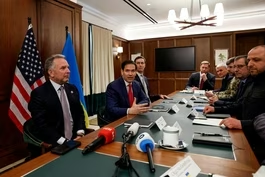
White House envoys met again## with Ukrainian officials in Miami today to# discuss President Trump's proposed path to## peace in Ukraine.
It was their# seventh meeting over.. including a session this past Sunday that# included Secretary of State Marco Rubio.
The State Department said# they've agreed on a key item,## a peacekeeping arrangement for post-war Ukraine.
The administration's national security# strategy, released this week, says ending## the war is a core U.S.
Interest in order# to stabilize European economies, prevent## unintended escalation or expansion of the war,# and reestablish strategic stability with Russia.
The congressionally mandated# document reflects a shift from the## stance of previous administrations,# including Mr.
Trump's first term.
Earlier, I spoke with Matthew Kroenig, vice# president and senior director of the Atlantic## Council's Scowcroft center for Strategy and# Security.
He helped write similar strategy## statements under Presidents George W. Bush# and Obama.
And in the first Trump term.
MATTHEW KROENIG, The Atlantic Council: I think# overall it was a good document with strengths,## but also with weaknesses.
So strengths,# a good strategy should tell you what's## new and different, and this one did that# with the focus on the Western Hemisphere.
It also had some new ideas for new challenges,# how the United States can maintain technological## leadership.
So I think those were the strengths.# On the weaknesses, I think it downplayed democracy## and human rights, which I think is a mistake,# was probably too critical of our European allies## and I think also downplayed the challenges# we face from autocratic rivals like China.
JOHN YANG: You're at the Reagan# National Defense Forum right now,## and I suspect there are# representatives from Europe.## What are you hearing from them or from# others at the forum about this document?
MATTHEW KROENIG: Yes, mixed opinions on# the document.
One European ambassador I## was speaking to last night said, you# know, this seems to be a consistent## message now following J.D.
Vance's tough# speech at the Munich Security Conference.
And so it would be irresponsible as# a European official not to question## America's commitment to Europe and to think# about how Europe might need to go its own way.
JOHN YANG: On Europe, the document says that# Europe faces the prospect of civilizational## erasure because of immigration policies and## suppression of political opposition.# What's your reaction to that?
MATTHEW KROENIG: Yes, well, I# do think that's something of an## extension of domestic politics for the# so called New Right in the Republican## Party.
And so I think they see their# enemies as liberals and progressives,## that's in the United States but also in Europe.# And so I think taking some of their domestic## political positions and exporting those to# Europe is what accounts for those passages.
JOHN YANG: You mentioned, the absence of# talking about democracy and human rights.## In their place, it seems to me the emphasis is on## economic relationships around the# world.
What do you think of that?
MATTHEW KROENIG: Our allies and partners in the# Western Hemisphere have often felt like they## are overlooked, that the United States# has paid more attention to Europe,## to the Middle East and to Asia.
And so# I think they see this new focus on the## Western Hemisphere as overall a good thing.
And# there's also talk about economic partnerships.
So I think that makes a lot of sense.
It's# one of the strengths of the strategy and## I think will be welcomed by the countries# that are the recipients of that investment.
JOHN YANG: This document is not only# different from previous presidents,## it's also different from Mr.
Trump's# first administration.
In that document,## the world was framed as competition between# those who favor repressive systems and## those who favor free societies.
What do you make of that change?
MATTHEW KROENIG: Well, you're right, that is a# big change.
The 2017 National Security Strategy,## the main takeaway was great power# competition with China and Russia.## This one kind of downplays the threat# from autocratic rivals.
North Korea## is not even mentioned.
Russia and China are# presented as not posing much of a challenge.
So I think the difference is the difference# in personnel.
And Trump won.
He was new to## Washington and so he was staffed by kind of# traditional Reaganite Republicans for this## administration.
He does have some# of those traditional Republicans,## but he also has more in the so called# restraint camp and populist camp.
And so I see the fingerprints of these# different groups on this document.
JOHN YANG: What do you see as the practical# impact of this document?
It's something that## Congress mandates that has to be produced.# But what sort of its practical significance?
MATTHEW KROENIG: It does have practical# implications.
Our allies and adversaries are## carefully reading this document.
As I mentioned,# I was talking about it with several allies## just over the past 24 hours.
But then it also# provides direction to the vast national security## bureaucracies.
Mid and lower level officials in# the Department of Defense, the State Department,## the intelligence community, want to know what# they should be doing on a day to day basis.
And## so this document does provide an authoritative# statement of the President's priorities.
JOHN YANG: How do you think this is# being read in Beijing or in Moscow?
MATTHEW KROENIG: Well, I think the answer# may be different.
It does talk a lot about## maintaining deterrence in the Indo Pacific.# It keeps our traditional policy with regard## to Taiwan talks about winning the economic# and technology competitions with China.
The Russia challenges presented almost as# squabbling between Europe and Russia and## almost positions the United States as a mediator# trying to restore.
So I suspect Putin will see## that as a step forward from his point of view,# compared to traditional strategies that I think## correctly portrayed Russia more as a threat# to Europe and a threat to the United States.
JOHN YANG: Matthew Krone from the# Atlantic Council, thank you very much.
MATTHEW KROENIG: My pleasure.# Thanks for having me.
JOHN YANG: In tonight's other headlines,# Arab leaders say it's time to move forward## on the second phase of the Israel-Hamas# ceasefire.
In remarks to the Doha Forum,## the Qatari prime minister said an# ongoing ceasefire agreement needs## to include the full withdrawal of# Israeli troops from the Gaza Strip.
The remarks came as Israeli Defense Forces# killed three people in an Israeli controlled## area of Gaza.
Two others died in# an airstrike outside Gaza City.
The next steps in President Trump's peace plan# call for international security force in Gaza,## the formation of a new government and Hamas giving# up its weapons, which it has not yet agreed to.
Devastation and desperation are evident in newly# released 911 calls from the July 4th weekend flash## flooding in Kerr County, Texas.
We want to warn# you that some viewers may find this distressing.
WOMAN: How many people are there?
WOMAN: There's three and we're stuck.
And it's# two elderly people.
Please help.
I can't -- WOMAN: Okay, really quickly.
Hey,# really quickly.
I need you to take## a really deep breath.
I understand we# have everybody headed that direction,## but I need you to take a deep breath.
Okay.# What's a good callback number for you?
WOMAN: I can't get -- I can't get# out and it's -- and I'm scared.
JOHN YANG: We don't know whether the woman in# that call was among the more than 130 lives## lost in the flooding.
Over the course of six# hours as floodwaters rushed through the area,## dispatchers handled more than 400 emergency calls.
The family of a National Guard member ambushed# blocks from the White House say they're optimistic## about his recovery.
They say Sergeant Andrew Wolfe# is looking more like himself and his head wound is## slowly healing.
He's expected to remain in# acute care for another two to three weeks.
Last night, there was a vigil for Wolfe at his# old high school in Berkeley County, West Virginia.## Army Specialist Sarah Beckstrom was also attacked# that day and later died from her injuries.
And the countdown to the Winter# Olympics in Italy has begun.
In Rome,## the Olympic flame began its journey to the# Games in Milan.
Over the next two months,## more than 10,000 torchbearers will participate in## a 7,000 mile relay through Italy.
The opening# ceremonies will be held on February 6th.
Still to come on PBS News Weekend,## how AI is helping predict premature births# and the risks and rewards of an icy plunge.
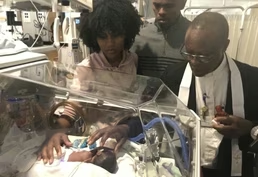
(BREAK) JOHN YANG: Last year, one in 10 U.S.
babies# was born before 37 weeks of pregnancy,## which is considered preterm.
The# March of Dimes says that's one## of the highest premature birth# rates among developed nations.
Preterm births can have long term health# effects and are hard to predict.
Ali Rogin## spoke with an entrepreneur who's using AI to# help doctors know when it's likely.
But first,## March of Dimes helped connect Ali with parents of# preterm babies to hear about their experiences.
ERICA SHOEMATE: My name is Erica# Shoemate and I am Mia's mom.
ROXANNE ROMEO: Hi.
My name is# Roxanne Romeo and I'm Zara's mom.
LUCERO PAYANO: My name is Lucero# Payano and I am Zael's mother.
RUBEN CONTRERAS: My name is Ruben# Contreras and I'm Zael's dad.
ASHLEY O'NEIL: My name is Ashley# o' Neil and I am Collin's mom.
EMMA LEE GREENLEY: My name is Emma# Lee Greenley and I'm Lois's mom.
ERICA SHOEMATE: My baby was born at 24# weeks, 2 days.
He she weighed 1 pound 7## ounces or the best that they could measure# so quick.
She was intubated immediately.
ROXANNE ROMEO: Zara was born at 26 weeks# and four days.
She weighed 2 pounds,## 6.7 ounces and she spent 93 days in the NICU.
LUCERO PAYANO: Zael was 25 weeks# and two days when I delivered him.
ERICA SHOEMATE: We learned that my daughter# actually has Ellis van Crevel syndrome,## which has less than 300 cases reported in# the world, but it's highly concentrated## in the Amish Dutch population.
It's very rare# in general, but then to be a family of color,## we only know two other families of color that# have been directly impacted in the world.
ASHLEY O'NEIL: I went into labor with Collins at## 25 weeks gestation at a small community# hospital that didn't have the resources## to properly care for a child.
He was# born at roughly a pound and a half.
ROXANNE ROMEO: Every day I would have to# call in the morning to talk to one of the## NICU nurses to find out how many# episodes she had the night before,## which is when a baby stops breathing.
And to even# imagine your child not breathing is just crazy.
ASHLEY O'NEIL: He fought.
He# was a feisty little thing,## repeatedly pulled out all of his# tubes.
But he came home 183 days later.
EMMA LEE GREENLEY: Lois is five years old now.# She is in preschool.
She's doing very well.
ERICA SHOEMATE: She just turned 8 on# September 27th.
It has been an honor,## a privilege to be this little rock star's mom.
ROXANNE ROMEO: She is a spunky, sassy little# toddler.
She's gonna be three in December.
LUCERO PAYANO: He is, thank God,## doing amazing.
When I tell people that# he's a 25-weeker, their jaws drop.
ASHLEY O'NEIL: Collin is six now.
He is in the# first grade.
He loves school.
He is non-speaking,## uses a communication device.
He does boss me# around, mom, iPad, please.
He has the best smile## that lights up a room.
He loves playing tricks# on his teachers.
If they ask him a question,## he'll hover over the right answer, giggle and# hit the wrong answer and giggle some more.
ROXANNE ROMEO: I just encourage people to# learn more about prematurity, especially## if you know you're pregnant or if you plan to# have a child.
And I'm not just talking about## women.
Fathers need to be in the know as well# because they are definitely part of this journey.
ERICA SHOEMATE: To anyone that is navigating this# thing that you never sign up for as a parent,## just know that you can get through it.
There# is life and love on the other side.
And also## to allow yourself the moments to grief, to# grieve through the grief of the pregnancy## you didn't have.
The parenthood experience# that you are not having or will not have,## and to also not allow yourself to# get in the business of comparing## your child to someone else's who is# not having the same experience as you.
ASHLEY O'NEIL: I share my story# a lot just to tell other people## that like I know how dark it can# get.
But if you just keep going,## eventually you'll find the light.
It may# not be as bright as you imagined or even the## same colors you imagine your light would look# like, but it can still beautiful nonetheless.
ALI ROGIN: We now turn to Robert Bunn,# an entrepreneur who knows this issue## firsthand.
He and his wife have four# daughters, but his wife experienced nine## miscarriages along the way.
Her experience# inspired him to work on technology that can## help predict whether a pregnancy will end# in a premature birth and help a medical## team prepare for that outcome.
Robert,# thank you so much for being here with us.
ROBERT BUNN, Founder, Ultrasound AI:# Thank you.
It's a pleasure to be here.
ALI ROGIN: Tell me a little bit more about# what.. your family and how that inspired# you to begin working in this field.
ROBERT BUNN: Sure.
We were# beginning to start our family.## My wife suffered numerous miscarriages,# and I was beginning to wonder why this## could happen over and over and# nothing could be done about it.
After doing a bit of research, because# I have no medical background, I had to## do some research to understand the problem.# What I realized is that the reason there's so## many premature births is because typically# they're a surprise.
And when they happen,## it's too late to do anything about that time.# And doctors typically don't have any forewarning.
And I so thought maybe if I could create# an AI that could predict that a premature## birth is impending, then doctors would# have a fighting chance to prevent that,## and they have time to do something about it.
ALI ROGIN: How does this technology know what# to look for and flag issues, potential issues?
ROBERT BUNN: I eventually learned that the# solution is to obtain millions of ultrasound## images, and then I have the outcomes of what# happened to those babies in those images.
Then## what I did is I created an AI that could# figure out how to map what was the pixels## in the images to what actually happened.# And I had to build a supercomputer from## parts in my basement to get the computer power# necessary.
And it took months to train this AI.
But basically what the AI eventually learned# how to do was to find patterns in these images## that then correlated to the actual outcomes, which# opened up a whole lot of new discoveries, as well## as the capability to predict the delivery date of# these babies, which then, of course, the doctors## could then act upon and determine if that was# going to work or if they needed to do something.
ALI ROGIN: Why is it traditionally so# difficult to screen for prematurity?
ROBERT BUNN: One is because ultrasound images are# not -- are hard to read.
They're very noisy.
It's## very hard to see things in them.
There are# some things that doctors know that typically## lead to premature birth, but those things# typically only happen to a small percentage## of women.
But the vast majority of women is# just you have a history of premature birth## or history of miscarriages.
So therefore# we'll monitor you closely in the future.
But it's not -- the accuracy is not as good as it# could be.
And I think that's the problem I needed## to solve is to give doctors very precise# delivery dates of when these babies were## going to be delivered so then they could# then act confidently to treat those women.
ALI ROGIN: I understand your# technology is already being used in## countries in South America.
What# have the results been like there?
ROBERT BUNN: They've been in trial use in# both Brazil and Chile and the doctors are## extremely happy.
Probably the biggest thing# that makes them happy is the fact that it's## able to identify the women who are on their# first child who may have a premature birth## so they can make sure those women get the care# they need they would not have gotten otherwise.
Then there's also the case where there's high risk# pregnancies and they want to keep the babies in## as long as possible because that reduces time# in NICU and they have a good idea of when the## baby's going to spontaneously deliver and# a spontaneous deliver may not be the best## choice in that case.
And they can do# a C section right before then.
So it## helps them time the deliveries that need# to be much better and have better outcomes.
ALI ROGIN: And then what's your outlook for# becoming available to people here in the US.
ROBERT BUNN: So we've recently submitted our# final review for the FDA and we hope to have## approval here very soon, maybe within the# next few months.
Nothing life is uncertain,## but we feel very good about this technology and## that its ability to begin saving the# lives of babies in America here too.
ALI ROGIN: Robert Bunn with# Ultrasound AI.
Thank you so much.
ROBERT BUNN: Thank you.# It's a pleasure being here.
JOHN YANG:## As the winter solstice nears, it might not feel# like the season for jumping in the water.
But## more and more people are finding an icy plunge# invigorating.
In this encore report, William## Brangham takes a look at the world of winter# swimming and its potential benefits and risks.
WILLIAM BRANGHAM (voice-over): Even# though the temperatures are plunging,## so are these swimmers, a brave# group in the northern Chinese## city of Harbin.
Taking a subzero# jump one by one into the icy water.
CHEN XIA (through translator): I felt# prickling all over my body.
The water here## is about 10 degrees Celsius lower than it is in# my hometown, but it still made me feel blissful.
WILLIAM BRANGHAM (voice-over):# These hardy souls are part of## the city's winter swimming team,# which boasts hundreds of members.## They say they train throughout the year to# develop the physical strength and mental## fortitude needed to dive into pools carved from# ice during the city's annual winter festival.
YU XIAOFENG (through translator):# Once these challenges are overcome,## you will feel the endless joy# brought by winter swimming.
WILLIAM BRANGHAM (voice-over): Endless joy# or crazy obsession?
In the Czech Republic,## locals there take to the cold waters of the Vltava## River in early January to mark# the end of the Christmas season.
SASA SELCAN (through translator): Well, I've# stuck with it.
It's a bit of an addiction now.
KAMIL NEMECEK (through translator): Once# you've tried it, you have to keep doing it.
WILLIAM BRANGHAM (voice-over): In# the Danish capital, Copenhagen,## it's a tourist draw to brave the icy water.
ORLANDO: It's crazy.
It's really refreshing.
I## think it's an experience that every single# person has to have once in their lifetimes.
EMILIANO: Here in winter.
ORLANDO: Yes, in winter.
And I love# it.
It's rea.. WILLIAM BRANGHAM (voice-over):# Devotees of winter swimming are## convinced these bone chilling dips# boost their health and happiness.
LIU SHURONG (through translator): Back in the day,## I used to get leg cramps and.. YOU DECANG (through translator):# I'm 76 years old, but I've never## got a cold because I swim in winter and I# feel very well.
It brings me good health.
WILLIAM BRANGHAM (voice-over): Online# advocates say the benefits are many,## helping with everything from migraines# to arthritis and even weight loss.
WOMAN: It boosts the immune system.
MAN: It really improves your mental health.
WOMAN: Great blood circulation# helps you sleep better.
WILLIAM BRANGHAM (voice-over):# But not everyone is convinced.
HEATHER MASSEY, University of Portsmouth: Some of# the claims that you'll see that splashed over the## web, we don't actually have good, robust evidence# to be able to support those claims at the moment.
WILLIAM BRANGHAM (voice-over):# Heather Massey studies cold## water immersion and swimming at the# University of Portsmouth in England.
HEATHER MASSEY: The level of# science is far more powerful## from the side of it having negative effects.
WILLIAM BRANGHAM (voice-over): Massey says the# initial plunge into icy water is shocking and the## body reacts instantly.
Shortness of breath, higher# blood pressure, even impaired cognitive function.
HEATHER MASSEY: Definitely make# sure you're well fit and healthy## before you go in.
If you've got# any underlying health problems or## you're not feeling great going in# cold water is not going to help.
WILLIAM BRANGHAM (voice-over): She says even# healthy people should proceed with caution.## There can be very real risks of hypothermia# and heart attacks.
But Massey is quick to add## there could be health benefits, and she and other# scientists are looking into what they might be.
HEATHER MASSEY: It may be that it's a# placebo effect.
But if it's a placebo## effect and it works well, it's still in effect.
WILLIAM BRANGHAM (voice-over): Evidence or not,## these swimmers can't seem to stay away from their# icy pl.. RITA EGG: It's so cold.
I was# freezing.
I'm saying if I can## do this, I can do anything in the# whole world.
That's my feeling.
WILLIAM BRANGHAM (voice-over): For PBS# News Weekend, I'm William Brangham.
JOHN YANG: And that is PBS News Weekend.
For this# Saturday, I'm John Yang.
For all of my colleagues,## thanks for joining us.
See you tomorrow.
How AI could help doctors predict premature births
Video has Closed Captions
Clip: 12/6/2025 | 8m 30s | 1 in 10 births in the U.S. are premature. Here’s how AI could help doctors predict it (8m 30s)
What to know about Trump’s new national security policy
Video has Closed Captions
Clip: 12/6/2025 | 5m 56s | National security strategist analyzes Trump administration’s new global policy (5m 56s)
Providing Support for PBS.org
Learn Moreabout PBS online sponsorship
- News and Public Affairs

FRONTLINE is investigative journalism that questions, explains and changes our world.

- News and Public Affairs

Amanpour and Company features conversations with leaders and decision makers.












Support for PBS provided by:
Major corporate funding for the PBS News Hour is provided by BDO, BNSF, Consumer Cellular, American Cruise Lines, and Raymond James. Funding for the PBS NewsHour Weekend is provided by...