
How the war in Iran is impacting global energy markets
Clip: 3/2/2026 | 7m 17sVideo has Closed Captions
How the war in Iran is impacting global energy markets
Oil and gas prices spiked on Monday as the Iran conflict escalated and shipping was disrupted in the Strait of Hormuz. About 20% of the world’s oil and liquefied natural gas flows through the strait every day, making it one of the most crucial oil supply routes on the planet. William Brangham reports.
Problems playing video? | Closed Captioning Feedback
Problems playing video? | Closed Captioning Feedback
Major corporate funding for the PBS News Hour is provided by BDO, BNSF, Consumer Cellular, American Cruise Lines, and Raymond James. Funding for the PBS NewsHour Weekend is provided by...
Support provided by:

How the war in Iran is impacting global energy markets
Clip: 3/2/2026 | 7m 17sVideo has Closed Captions
Oil and gas prices spiked on Monday as the Iran conflict escalated and shipping was disrupted in the Strait of Hormuz. About 20% of the world’s oil and liquefied natural gas flows through the strait every day, making it one of the most crucial oil supply routes on the planet. William Brangham reports.
Problems playing video? | Closed Captioning Feedback
How to Watch PBS News Hour
PBS News Hour is available to stream on pbs.org and the free PBS App, available on iPhone, Apple TV, Android TV, Android smartphones, Amazon Fire TV, Amazon Fire Tablet, Roku, Samsung Smart TV, and Vizio.
Providing Support for PBS.org
Learn Moreabout PBS online sponsorshipAMNA NAWAZ: Let's shift our focus# now to the war's impact on the## global energy market.
Oil and gas# prices spike today as the regional## conflict escalated and shipping was# disrupted in the Strait of Hormuz.
About 20 percent of the world's oil and liquefied# natural gas flows through the strait every day,## making it one of the most crucial# oil supply routes on the planet.
William Brangham joins us now with more.
WILLIAM BRANGHAM: Amna, at least five# tankers have been damaged in the vicinity## of the strait since Saturday, and traffic slowed# dramatically there over the weekend.
Separately,## Iranian drones continue to attack# energy infrastructure in different## Arab Gulf states.
Today, those# attacks damaged an oil refinery## in Saudi Arabia and halted the production# of liquid natural gas, or LNG, in Qatar.
So to help us understand these impacts# and implications, we are joined by Dan## Pickering.
He's the chief investment# officer at Pickering Energy Partners,## which is a financial services and advisory# firm that is focused on the energy industry.
Dan, thank you so much for being here.
Let's pick apart some of these different impacts,## first on the markets.
What# happened with oil prices today?
DAN PICKERING, Chief Investment Officer,# Pickering Energy Partners: Yes, William,## we had a strong rally at oil pric.. WTI, the U.S.
benchmark, was about $72# a barrel.
It was actually up less than## many people expected.
So the markets did# better, the broad stock markets did better,## and oil didn't rise quite as much# as expected, but still up strongly.
WILLIAM BRANGHAM: And we mentioned the# importance of the Strait of Hormuz and## the attacks and the trickiness of what's going on## there right now.
What do we know is# the latest happening in the strait?
DAN PICKERING: Yes, the latest# is essentially tanker traffic has## slowed to almost nothing.
Some vessels,# primarily Iranian vessels, are continuing## to move through the strait.
But because it's# dangerous, because there have been attacks,## there's not a lot of oil moving through# there.
And as we know, it is a big choke## point for global supply; 20 percent of# global supply comes through the straits.
And it's essentially shut down right now.
WILLIAM BRANGHAM: I mean, obviously, this is# the main route.
That's why everyone has been## using it for so many years.
Is there or are there# any alternate routes to get that oil to market?
DAN PICKERING: For oil, there are# some other pipeline export routes,## maybe five million barrels a day, so, remember,# 20 million through the straits.
Perhaps five## million of it can get to market other ways.
So 15# percent of supply is trapped behind the straits.
On the gas side of the equation, there# really is no other output for Qatar's## liquefied natural gas.
And so that is# kind of 100 percent blocked right now.
WILLIAM BRANGHAM: Do you have# a sense of what Iran could do## to both increase the pressure on the# limited traffic that's going through,## and what might the Americans or allies# do to alleviate that choke point?
DAN PICKERING: When we think# about what could happen from here,## if Iran wants to ratchet up the tensions, it# probably wouldn't be in the Straits of Hormuz,## where they have already had# a big effect slowing traffic.
It would be lashing out at the energy# infrastructure of the other Gulf states,## so attacking Saudi Arabia's capabilities,# attacking Kuwait, Oman, the United Arab## Emirates.
So I think that the actions that# the U.S.
and the allies would likely take## will be to try and safeguard the straits, whether# using doing that militarily with escorts and/or## aerial support, and potentially creating a# financial backstop that would allow tanker## traffic to move through without fear# that the damage would be uninsured.
WILLIAM BRANGHAM: Right.
I mean, you mentioned some of .. those already.
What does this say about# the state of the conflict that Iran is## right now reaching out, trying to attack# those other states and other refineries?
DAN PICKERING: I think it says this is# clearly different than what we saw in June,## obviously, a much bigger conflict and one# in which Iran is prepared to fight back,## and fight back aggressively.
I would say, though, that the first# 48, 72 hours are very important,## and no significant infrastructure damage# has happened across the Middle East.
And so## I think we have to feel good that there# hasn't been more damage or more impact.## And my expectation is, we will probably fix# the Straits of Hormuz within the next 10 days.
And so this is absolutely a flash point# in time, but one that is probably going## to ease in terms of risk as we move# through the next week to two weeks.
WILLIAM BRANGHAM: I want to ask you about this# one.
There was one attack on an LNG facility,## liquid natural gas facility, in Qatar.
And European gas prices surged# quite dramatically after that.## How significant is the loss of that one# facility or an attack on that one facility?
DAN PICKERING: Yes, Qatar, they're# 20 percent of global LNG supply,## and it all flows through the straits.# And so when you take 20 percent offline,## which has happened now, not# damage to the facility, per se,## but just forced to shut in because they can't# export their gas, 20 percent is a big impact.
So, European prices escalated.
A lot of that LNG# goes to Asia.
And so those shortages will be felt## in the next call it month or so.
But European# prices react because the whole global market has## now tightened.
Not a lot of excess LNG capacity# around the world to offset those shut-ins.
WILLIAM BRANGHAM: I mean, I know we are# in early days and all of these things are## predictions at this point.
Do you have# any sense as to whether or not and when## American consumers might feel the# ripple effects of this conflict?
DAN PICKERING: Yes, I think we're# very lucky here in the United States,## from the perspective that, because of the# shale revolution, because of the fact that## the U.S.
has become the world's largest# oil producer at 14 million barrels a day## and a very significant gas producer,# we're pretty self-sufficient here.
And so we should be relatively insulated from# what's happening.
Global prices will impact U.S.## prices, but oil in the 70s, gasoline prices should# stay relatively muted.
So unless things escalate## from here, we should see relatively little# impact in the U.S., unless things escalate.
WILLIAM BRANGHAM: All right, that is Dan# Pickering of Pickering Energy Partners.
Thank you so much for being here.
DAN PICKERING: Glad to be here.
Expert panel breaks down U.S. objectives in Iran war
Video has Closed Captions
Expert panel breaks down U.S. objectives in Iran war (9m 9s)
Hezbollah and Israel reignite conflict after Iran strikes
Video has Closed Captions
Hezbollah and Israel reignite conflict in Lebanon after Iran strikes (4m 4s)
Iran expands attacks, U.S. urges Americans to leave Mideast
Video has Closed Captions
As Iran expands retaliatory attacks, U.S. urges Americans to leave Middle East (9m 19s)

News Wrap: FBI says Texas shooting could be terrorism
Video has Closed Captions
News Wrap: FBI investigating Texas shooting as potential act of terrorism (4m 54s)
Reporter in Tehran describes tense and volatile conditions
Video has Closed Captions
On the ground in Tehran, reporter describes tense and volatile conditions (4m 10s)
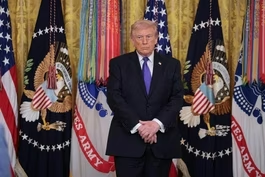
Trump leaves door open for ground troops in Iran
Video has Closed Captions
Trump leaves door open for ground troops in Iran (4m 38s)

What's at stake for Dems, GOP in Texas Senate primaries
Video has Closed Captions
What's at stake for Democrats and Republicans in the Texas Senate primaries (6m 50s)
Providing Support for PBS.org
Learn Moreabout PBS online sponsorship
- News and Public Affairs

FRONTLINE is investigative journalism that questions, explains and changes our world.

- News and Public Affairs

Amanpour and Company features conversations with leaders and decision makers.












Support for PBS provided by:
Major corporate funding for the PBS News Hour is provided by BDO, BNSF, Consumer Cellular, American Cruise Lines, and Raymond James. Funding for the PBS NewsHour Weekend is provided by...