
Prisoners Riot to Protest Poor Conditions and Abuse
There is a string of prison uprisings as prisoners protest abuse and unfair living conditions.
From
Prisoners Riot to Protest Poor Conditions and Abuse
Clip: Episode 3 | 5m 32sVideo has Closed Captions
There is a string of prison uprisings as prisoners protest abuse and unfair living conditions.
America's prisons are in terrible condition by the 1950s and 60s, and prisoners protest the living conditions and abuse they face. As the years drag on, the protests become more violent and turn into riots. But, they are successful at bringing attention to the cruel living conditions, and many states vow to reform their prison systems.
From
Problems playing video? | Closed Captioning Feedback
Problems playing video? | Closed Captioning Feedback
Episodes presented in 4K UHD on supported devices. Major funding for CRIME AND PUNISHMENT IN AMERICA was provided by The Atlantic Philanthropies, Emerson Collective, The Andrew W. Mellon Foundation, and...
Prisoners Riot to Protest Poor Conditions and Abuse
Clip: Episode 3 | 5m 32sVideo has Closed Captions
America's prisons are in terrible condition by the 1950s and 60s, and prisoners protest the living conditions and abuse they face. As the years drag on, the protests become more violent and turn into riots. But, they are successful at bringing attention to the cruel living conditions, and many states vow to reform their prison systems.
From
Problems playing video? | Closed Captioning Feedback
Where to Watch Crime and Punishment in America
Crime and Punishment in America is available to stream on pbs.org and the PBS app.
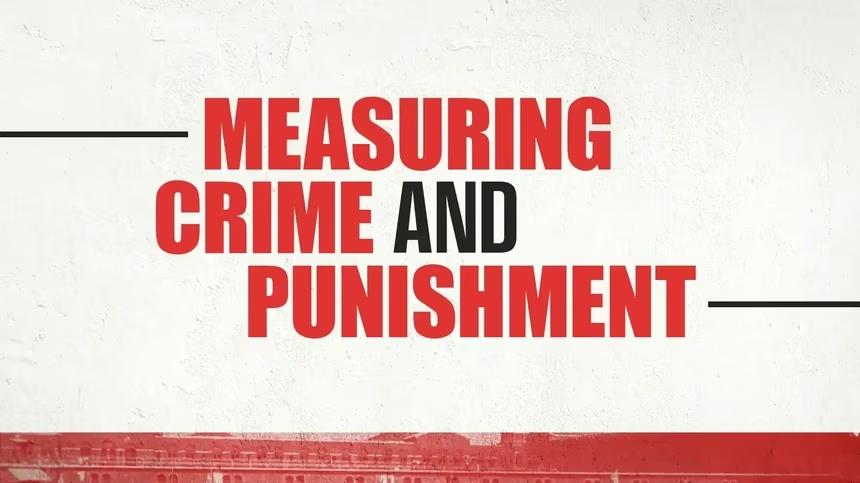
Measuring Crime and Punishment
How does the way we collect and measure crime shape our understanding of it? Crime statistics can tell us how crime changes over time. But the way crime is measured, defined, and communicated can also shape public perception and policy.Providing Support for PBS.org
Learn Moreabout PBS online sponsorshipVoice: No one has ever asked me if I have seen evidence of brutality at Angola.
But I have seen plenty.
There is no trade school, no handicrafts, or arts, not even a library.
A man sentenced here who cannot read or write leaves here the same way.
No effort is made to help him stay out of the penitentiary once he obtains his release.
The penitentiary is a cancer on the soul of every citizen in the state of Louisiana, who knows of the conditions at Angola and has made no effort to remedy them.
Nurse Mary Margaret Daughtry.
Singer: ♪ You know that poor boy ♪ ♪ Is dead and gone... ♪ Narrator: The Louisiana State Penitentiary, Angola, was built on the site of a former plantation, and nearly 100 years after emancipation, it was still run like one.
So were other prison farms across the South: Parchman in Mississippi, Imperial in Texas, and Cummins in Arkansas.
In 1951, to protest the conditions at Angola, 31 prisoners severed their Achilles tendons with razors.
When a reporter asked why they had done it, most gave the same answer: I had to get out from under that stick.
Thompson: Southern prisons were in such terrible, terrible shape, but Northern prisons also were hell holes in the 1950s and '60s.
And this comes to light because prisoners themselves start to stand up.
We see a spate of uprisings.
♪ Newsreel reader: A wave of prison riots in Eastern States is touched off by inmates of the Trenton, New Jersey, Reformatory, and later spreads to Rahway Reformatory, where state troopers take over to restore order.
231 convicts barricade themselves in a prison barracks, holding eight guards as hostage.
While in Michigan, a still more violent outbreak takes place in the penitentiary at Jackson, the largest walled prison in the world.
Only after state troopers armed with machine guns open fire is the main body of prisoners forced back into cells, leaving one dead and seven wounded.
Whatever investigations disclose, the prison uprisings have focused new interest on our penal institutions.
♪ Thompson: The people who are locked inside of those places, the people who society has deemed often the worst of the worst are saying, "Even though we are in here "and even though we are doing what was asked of us, "which is to serve our time, "where does it say in here that we can't have "decent medical care "or that we cannot practice our religion?
"Where does it say that we have somehow checked our right to be free of cruel and unusual punishment?"
What is so kind of fundamental at the core of these rebellions is the simple desire to be treated as human beings.
Narrator: Amidst growing concern about the nation's prisons, many states pledged to reform their agencies.
Some wardens promised to focus on rehabilitation.
The American Prison Association changed its name to the American Correctional Association.
In 1953, a new warden took over the Tennessee State Prison in Nashville.
He encouraged a doo-wop group in the prison to perform, and invited scouts from a new R&B music label, Sun Records, to come hear them.
Singer: ♪ Just walkin' in the rain ♪ ♪ Getting soaking wet ♪ Narrator: The producers were impressed, and, with the warden's permission, brought the singers to their studio in Memphis for a recording session.
They called themselves The Prisonaires.
Their first record, "Just Walkin' in the Rain," sold 250,000 copies, and was one of Sun Records' first big hits.
The Prisonaires performed in the governor's mansion, on the radio, and on television.
Prisonaires: ♪ All because my heart ♪ ♪ Still remember you... ♪ ♪ Who-oa, ooh... ♪ Betts: There is something about trying to create art, which is trying to create a story about our life that you might think wasn't possible when all you focused on was, like, the system and the number of people in prison.
I became a poet in prison.
You know what I mean?
So, so for me, I do think that there's a narrative to be said about the musical tradition of folks who came up out of prison.
It's always been that way.
People are literally producing a present for themselves, even if they have life at the back end of their sentence.
Prisonaires: ♪ I can't forget... ♪
 New
'Criminal justice ... is as much about regulating morals' as safety
Video has Closed Captions
Clip: Ep3 | 38s | The criminal justice system is weaponized to police morals and regulate women's autonomy. (38s)
 New
Dragnet, the Thin Blue Line, and Improving the LAPD's Image
Video has Closed Captions
Clip: Ep3 | 5m 16s | LAPD Chief William Parker works with the TV show Dragnet to improve the department's public image. (5m 16s)
 New
Fred Korematsu Fights Internment
Video has Closed Captions
Clip: Ep3 | 10m 47s | Fred Korematsu defies President Roosevelt's order to detain everyone of Japanese descent. (10m 47s)
 New
J. Edgar Hoover and the FBI Fight the War on Crime
Video has Closed Captions
Clip: Ep3 | 7m 17s | To win the new war on crime, the FBI sets their sights on famous targets like John Dillinger. (7m 17s)
 New
Richard Whitney and the Investigation of White Collar Crime
Video has Closed Captions
Clip: Ep3 | 6m 22s | The Senate Banking Committee investigates Richard Whitney and other white collar criminals. (6m 22s)
Providing Support for PBS.org
Learn Moreabout PBS online sponsorship







Support for PBS provided by:
Episodes presented in 4K UHD on supported devices. Major funding for CRIME AND PUNISHMENT IN AMERICA was provided by The Atlantic Philanthropies, Emerson Collective, The Andrew W. Mellon Foundation, and...