
The complicated road to recovery for Indian sex workers
Clip: 2/5/2026 | 8m 58sVideo has Closed Captions
The complicated road to recovery for Indian women forced into sex work
As many as 3 million women in India are believed to be sex workers, often pushed into the trade by extreme poverty or coercion. One organization has helped more than 32,000 of these women find a path out. While this group has earned international awards and philanthropic support, it’s also raised complex questions about how best to help. Fred de Sam Lazaro reports for his series Agents for Change.
Problems playing video? | Closed Captioning Feedback
Problems playing video? | Closed Captioning Feedback
Major corporate funding for the PBS News Hour is provided by BDO, BNSF, Consumer Cellular, American Cruise Lines, and Raymond James. Funding for the PBS NewsHour Weekend is provided by...
Support provided by:

The complicated road to recovery for Indian sex workers
Clip: 2/5/2026 | 8m 58sVideo has Closed Captions
As many as 3 million women in India are believed to be sex workers, often pushed into the trade by extreme poverty or coercion. One organization has helped more than 32,000 of these women find a path out. While this group has earned international awards and philanthropic support, it’s also raised complex questions about how best to help. Fred de Sam Lazaro reports for his series Agents for Change.
Problems playing video? | Closed Captioning Feedback
How to Watch PBS News Hour
PBS News Hour is available to stream on pbs.org and the free PBS App, available on iPhone, Apple TV, Android TV, Android smartphones, Amazon Fire TV, Amazon Fire Tablet, Roku, Samsung Smart TV, and Vizio.
Providing Support for PBS.org
Learn Moreabout PBS online sponsorshipWILLIAM BRANGHAM: In India, as many as# three million women are believed to be## sex workers.
They're often pushed into the# trade because of extreme poverty or coercion.
We bring you the story tonight of one organization# that's helped more than 32,000 of these women## find a pathway out.
While this group has earned# international awards and philanthropic support,## it has also raised complicated questions# about how best to help these women,## especially those who aren't asking to be rescued.
Fred de Sam Lazaro has our story.
It's# part of his series Agents For Change.
FRED DE SAM LAZARO: The games, dancing# and loud music mean it's Friday night## at Prajwala and the staff are# taking a moment for themselves.
Most of the women here share a deep bond# over their complex, painful histories,## beginning with the founder.
She stands just# 4'6'' tall, but hers is her commanding presence.
SUNITHA KRISHNAN, Founder, Prajwala: I was a## high achiever and ever.. FRED DE SAM LAZARO: That was until age 15,## when she was gang raped by eight men.# Sunitha Krishnan says, far more painful## than the physical trauma was the social# indifference or innuendo that she endured.
SUNITHA KRISHNAN: I was loose.
I was fallen.
FRED DE SAM LAZARO: They were blaming you.
SUNITHA KRISHNAN: Everybody.
Everybody.# And I had loose morals.
We want .. to behave in a particular way.
We want her# to feel ashamed, guilty.
I chose not to.
FRED DE SAM LAZARO: Instead, she says the# ordeal helped her focus as an aspiring## social worker on the fight against what# she calls an age-old culture of misogyny,## manifest in sexual assaults and# a thriving prostitution industry.
This is Prajwala's base camp.
Thirty years ago, she founded the organization# called Prajwala, or Eternal Flame, to shelter## women removed in police raids from brothels# and to police the police, ensuring that raids## are actually conducted and that the women, widely# marginalized in India, are treated with respect.
Since then, thousands have come# through Prajwala's various programs.## As I talked to groups of survivors# around the campus, almost everyone's## story began with dire poverty that left them# vulnerable to an extensive trafficking mafia.
LAKSHMI PRIYA, Trafficking Survivor# (through translator): My husband's## sister brought me to Hyderabad an.. FRED DE SAM LAZARO: Lakshmi Priya fell# victim into a scam marriage scheme.
LAKSHMI PRIYA (through translator): They took my# daughter away from me and, for the sake of her## safety, I used to do whatever they forced me to# do.
If I didn't, they would beat me very harshly.
NAZIA, Trafficking Survivor (through# translator): My father died in a road## accident and I was left with# a mother and a small brother.
FRED DE SAM LAZARO: Nazia became her family's# breadwinner as a teenager and was convinced by## a trafficker that there was better paid work in# Hyderabad.
It turned out to be in the sex trade.
NAZIA (through translator): Sometimes I used# to attend 20 customers per day.
They would## make us drink and smoke.
And if we didn't do# the work, they would beat us very harshly.
SIRAJ, Trafficking Survivor# (through translator): I wanted to## die instead of living th.. FRED DE SAM LAZARO: Siraj was promised training# and a tailoring job 1,000 miles from her home## in the capital, Delhi.
She found herself# in a brothel, and she found a razor blade.
SIRAJ (through translator): After# I cut my hand a lot of blood came## out and I became unconscious.
I# don't know what happened later.
FRED DE SAM LAZARO: She was picked up hours later# by police and eventually placed in this shelter.
SIRAJ (through translator):# Today, she's trained and employed# by Prajwala as a bookbinder earning a decent wage.
SUNITHA KRISHNAN: This is a# product that we are doing.
FRED DE SAM LAZARO: Bookbinding is one of# several training initiatives that double## up as revenue-generating businesses,# training survivors in skills ranging## from tailoring to welding to carpentry and# paying them and their teachers' salaries.
SUNITHA KRISHNAN: When they go to construction# sites, everybody, like, stands back, oh,## my God, women welders, we have never seen# them.
So coming from a perception which## is indoctrinated into them in the brothel, that# you go out, everybody is going to throw you out,## nobody is going to accept you, suddenly,# when you get that sense of respect.
FRED DE SAM LAZARO: But the journey# to achieving the success is arduous.## It can take years to overcome# trauma and learn new skills,## and not everyone agrees it's the right# approach to dealing with the sex industry.
Some human rights advocates and people who# work in the sex industry take issue with## what they call the raid-and-rescue approach# that brings women to Prajwala's shelters.## Most of these women, they say, are not actually# trafficked and go into the business voluntarily,## albeit because their poverty and# illiteracy give them few other options.
Nonetheless, they say, these women are in the# business voluntarily and don't want to be rescued.
VIBHUTI RAMACHANDRAN, University of California,# Irvine: Why is someone doing domestic work?## Why is someone doing factory work?
It's not# necessarily their number one choice of what## they wanted to do.
It's within the constraints# of their education and their economic status.
FRED DE SAM LAZARO: Vibhuti Ramachandran## is an anthropologist at the# University of California, Irvine.
VIBHUTI RAMACHANDRAN: So why are we# exceptionalizing the sex industry is## a question worth asking, right?
And# then whose morality is shaping that?
FRED DE SAM LAZARO: Prostitution is# technically a legal profession in India,## but the law criminalizes related activities# like soliciting or operating a brothel.
Brothel raids are the most# common law enforcement tactic,## removing women who are automatically presumed# to be trafficking victims and placing them in## protective shelters for rehabilitation,# to which they're entitled by law.
Ramachandran says the approach has been heavily# influenced by U.S.
policy in recent decades.
VIBHUTI RAMACHANDRAN: With the Bush administration# in the early 2000s, where there was a lot## of importance given to anti-trafficking# and there was money associated with it.
FRED DE SAM LAZARO: The result, she and others# say, is a patchwork of shoddy enforcement,## many substandard shelters and a confiscation of# these women's most viable way to earn a living.
VIBHUTI RAMACHANDRAN: There's a lot of# emphasis on training and reforming these women,## right?
But a lot of them say, we don't have# time for that.
We can't afford to be learning.
SUNITHA KRISHNAN: We have books.
FRED DE SAM LAZARO: Sunitha Krishnan says the# solution is to improve the quality of shelters## and rehab programs.
Prajwala receives# high marks for its vocational training,## but it too has faced protests from women# seeking to leave its fortified shelters,## including escape attempts and at# least one woman who died from suicide.
Getting released from a shelter often involves# tedious procedures through a notoriously slow## court system.
And rehabilitation is# no walk in the park, says Krishnan.
SUNITHA KRISHNAN: From trauma# care to support in medical care,## de-addiction, detoxification, all this takes time.
FRED DE SAM LAZARO: So it's# not surprising, she says,## that women want to escape from shelters and up# to 15 percent of them do return to sex work.
SUNITHA KRISHNAN: The large number of them# have gone back because of other compulsions,## like a Stockholm syndrome or a trauma bond# that they have developed with an abuser.
FRED DE SAM LAZARO: When it comes to sex work,# she calls herself steadfastly abolitionist.
Sex work, in your mind, cannot be a# profession like most other professions.
SUNITHA KRISHNAN: I don't believe so.# I believe it is the oldest form of## patriarchal legitimization of commodifying# a woman's body as a sexual object.
FRED DE SAM LAZARO: Education is key to bringing# fundamental change to give young people options,## Krishnan says.
She took me to a mainstreaming# program Prajwala runs in distressed neighborhoods## to help children who are not in school# through tutoring or school readiness programs.
This, it is hoped, would mean a more# straightforward vocational journey for## the next generation than that of the women# that Prajwala shelters and their children.## Lakshmi Priya is reunited with her daughter,# who is now in her first year of law school.
For the "PBS News Hour," I'm Fred# de Sam Lazaro in Hyderabad, India.
How public opinion against ICE may affect funding showdown
Video has Closed Captions
How public opinion shifting against ICE may affect the DHS funding showdown in Congress (5m 23s)

How ‘zombie mortgages’ are coming back to haunt homeowners
Video has Closed Captions
How ‘zombie mortgages’ are coming back to haunt homeowners years later (10m 51s)
Humanitarian group head urges nations to step up Sudan aid
Video has Closed Captions
Head of humanitarian group urges nations to step up Sudan aid to prevent ‘biblical’ famine (5m 43s)
RSF siege of Sudanese city leaves overwhelming suffering
Video has Closed Captions
Sudanese army finds overwhelming suffering after breaking RSF siege of embattled city (5m 7s)
Search continues for Nancy Guthrie as authorities seek leads
Video has Closed Captions
Search continues for Nancy Guthrie as authorities seek leads to find suspects (3m 45s)
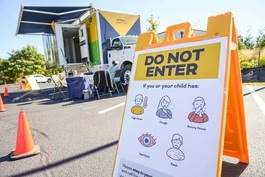
What to know about South Carolina’s big measles outbreak
Video has Closed Captions
What to know about South Carolina’s big measles outbreak and who is most at risk (6m 43s)
Providing Support for PBS.org
Learn Moreabout PBS online sponsorship
- News and Public Affairs

FRONTLINE is investigative journalism that questions, explains and changes our world.

- News and Public Affairs

Amanpour and Company features conversations with leaders and decision makers.












Support for PBS provided by:
Major corporate funding for the PBS News Hour is provided by BDO, BNSF, Consumer Cellular, American Cruise Lines, and Raymond James. Funding for the PBS NewsHour Weekend is provided by...